
Commercial Make-Up Air Units
A wrong commercial make-up air unit costs twice. Once for the install, and again for the retrofit when it doesn’t match the application.
Undersized units let negative pressure win.
Oversized units waste energy every hour they run.
Units with the wrong heating source create condensation damage or air quality problems that trigger code violations. The fix isn’t buying a bigger unit or a more expensive one.
The fix is matching the unit to the building, the exhaust load, and the climate before anything gets bolted to the roof.
We work across multiple manufacturer lines to spec one recommendation for your facility. Not the unit that’s closest to what you need. The unit that’s right.
Authorized Commercial Make Up Air Suppliers
We are the authorized distributors for the leading American manufacturers of makeup air units. We’ll be pleased to provide the ideal make up air unit for your application as authorized representatives.
For a fast quote or if you have inquiries about commercial or industrial MUA, get in touch with us.
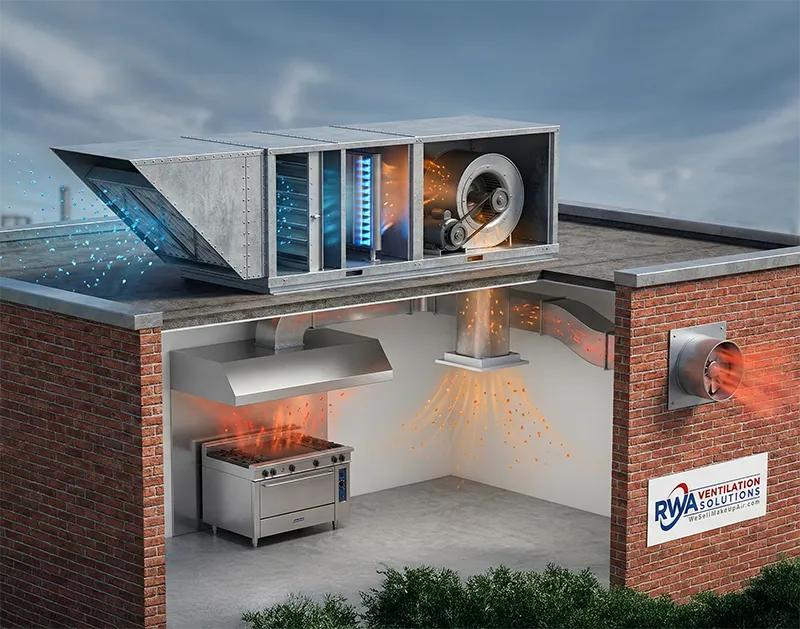
Types of Commercial Make-Up Air Systems
Commercial make-up air units fall into a handful of categories based on how they handle incoming air. Some heat it. Some heat and cool it. Some do neither. The right type depends on your climate, your exhaust volume, and whether the space needs year-round temperature control or just pressure balance.
| System Type | What It Does | Best For |
|---|---|---|
| Direct gas-fired | Heats incoming air by passing it directly through a flame. Nearly 100% thermal efficiency. | Warehouses, manufacturing, loading docks where combustion byproducts in the airstream are acceptable |
| Indirect gas-fired | Heats incoming air through a heat exchanger. Combustion gases stay separated from supply air. | Facilities with strict air quality requirements, pharmaceutical, food processing |
| Rooftop packaged (heated and cooled) | Combines heating, cooling, and ventilation in a single rooftop unit. | Commercial buildings needing year-round comfort control with limited mechanical room space |
| DOAS (dedicated outdoor air system) | Supplies fully conditioned outdoor air with precise temperature and humidity control. | High-occupancy buildings, spaces with strict humidity requirements |
| Untempered | Brings in outside air without heating or cooling. Relies on building HVAC to handle the load. | Mild climates, facilities where exhaust replacement is the only goal |
Climate drives the first decision. A facility in Phoenix has different needs than one in Minneapolis. Exhaust volume drives the second.
A 30,000 CFM hood system demands a different solution than a 5,000 CFM process exhaust fan.
No single manufacturer builds the best unit in every category, which is why starting with the application instead of the brand catalog gets you to the right answer faster.
What Goes Wrong With the Wrong Commercial MUA
A commercial make-up air unit that doesn’t fit the building doesn’t just underperform. It makes everything else work harder.
Energy bills go up. Equipment wears out faster.
And the fix is always more expensive than getting it right the first time.
Too Small
- Exhaust fans can’t pull air out because nothing is replacing it
- Doors get hard to open
- The building stays uncomfortable no matter what you adjust
Too Big
- You pay to heat or cool air the building doesn’t need
- The unit turns on and off constantly, which burns out components early
- People inside feel hot, then cold, then hot again
Wrong Type
- A direct-fired unit in the wrong application puts combustion gases into the air people breathe. Inspectors catch it. Then you’re replacing the whole unit.
- An indirect-fired unit where a direct-fired unit would work costs 20-40% more to run every year. For nothing.
All three end the same way. A second install to undo the first one.
One conversation up front avoids all of it.
Why Manufacturer-Agnostic Sourcing Gets It Right the First Time
A manufacturer rep recommends what they sell. If their lineup doesn’t have the right fit for your building, you get the closest option they carry. Close enough isn’t right.
We work across multiple manufacturer lines. When you call, we spec the unit based on your exhaust volume, your climate, and your building requirements. Not based on what one company happens to make.
What That Means for You
- One call instead of shopping three or four manufacturers yourself
- A recommendation based on your application, not someone’s sales quota
- Every unit is US-made and backed by the manufacturer’s full warranty
One call. The right unit. No retrofit.
Talk to an application engineer at 847-262-3457 ext. 23.
Commercial MUA FAQ
How much does a commercial make-up air unit cost?
Cost depends on the unit type, CFM capacity, and whether heating or cooling is included. A small untempered unit for pressure balance costs far less than a large rooftop system with full climate control. The gap between a right-sized unit and a retrofit after a bad spec is where the real money goes.
What size make-up air unit do I need?
Start with total exhaust CFM. Your make-up air capacity should replace 80-90% of what leaves the building. The remaining gap maintains slight negative pressure to keep contaminants from spreading between zones. Climate, ceiling height, and door traffic all affect the final number.
What is the difference between tempered and untempered make-up air?
Tempered units heat or cool incoming air before it enters the building. Untempered units bring outside air in as-is. In cold climates, untempered air drops the space temperature every time the system runs. In mild climates, untempered works fine and costs less to install and operate.
Do I need heating and cooling in my make-up air unit?
Depends on your climate and what the space requires. Heating-only works in regions with mild summers. If the building needs year-round comfort control or handles humidity-sensitive processes, a heated and cooled system prevents temperature swings and moisture problems that affect both people and product.