Contact

info@wesellmakeupair.com

Call us

847-262-3457 ext. 23

We're Available

Mon - Fri: 8:30 - 5:00 CST

DOAS Ventilation and Load Sizing Calculator

This calculator sizes your dedicated outdoor air system in 3 steps. Enter your space type and occupancy to get ASHRAE 62.1 ventilation CFM. Add your project location to get cooling tonnage through the enthalpy method and heating MBH through sensible heat. 

Standard BTU calculators treat outdoor air like recirculated air. DOAS units handle 100% outside air across the full range of ambient conditions. That means latent loads in summer and extreme temperature differentials in winter.

Generic tools miss both.

You get ventilation, cooling, and heating loads from one tool, built around the formulas your specs already require.

01
Ventilation Airflow (ASHRAE 62.1)
How much outdoor air does your space require?
Auto-set by space type
CFM/person
Auto-set by space type
CFM/ft²
Number of people in the space
people
Total area of the zone
ft²
Based on supply air delivery method
Healthcare spaces (patient rooms, exam rooms) are governed by ASHRAE Standard 170, not 62.1. Use manual CFM entry in the load panels below for healthcare applications.
Required Ventilation
Calculation
CFM flows to panels 2 & 3
02
Cooling & Dehumidification Load
Total cooling capacity your DOAS coil must handle at peak summer conditions
From Step 1 or enter manually
From Step 1 CFM
Sets summer & winter design temps
Auto-set from location
°F
DOAS coils typically deliver 52-55°F saturated
°F
Total Cooling Load
Approximate Tonnage
CFM & location flow to panel 3
03
Heating Load
Heating capacity required to temper outdoor air in winter
From Step 1 or enter manually
From Step 1 CFM
Sets your winter design temperature
From Step 2
Temperature of air entering your space
Heating Load
Heating Capacity
System Analysis

Your DOAS System Requirements

Ventilation
Cooling
Heating

Supply Air Strategy

Neutral Air
Reheat penalty
Parallel offset0 BTU/h
Total system load
Energy Recovery (ERV) | Reduces peak coil load by ~30%
Actual savings vary 20-40% depending on device effectiveness, climate, and operating hours.

Need precise dewpoint and dehumidification specs?
Our engineers size DOAS coils for your exact building conditions, pulling options from multiple manufacturers.

Get a Quote With These Specs 847-262-3457 ext. 23

Share this DOAS Calculator!

Have questions? Contact an engineer.

How Much Outside Air Does Your Space Need?

Your DOAS unit supplies 100% outdoor air. The required volume depends on how many people occupy the space and how large it is. ASHRAE Standard 62.1 defines minimum ventilation rates for both variables.

ASHRAE 62.1 Ventilation Rate Formula

People
Component
Area
Component
Ventilation
Effectiveness
Voz = (Rp × Pz + Ra × Az) / Ez

VariableDefinitionUnit
RpPer-person ventilation rateCFM/person
PzNumber of occupants in the zonePeople
RaPer-area ventilation rateCFM/sq ft
AzZone floor areaSquare feet
EzVentilation effectiveness (adjusts for supply air distribution)Decimal

Exhaust-match sizing pulls a number from hood specs and stops there. The 62.1 method sizes ventilation to actual occupant density and space function. A 5,000 square foot restaurant dining room and a 5,000 square foot warehouse need vastly different outdoor air volumes. This formula captures that difference.

Authorized DOAS Suppliers

We are the authorized distributors for the leading American manufacturers of makeup air units. We’ll be pleased to provide the ideal make up air unit for your application as authorized representatives.

For a fast quote or if you have inquiries about commercial or industrial MUA, get in touch with us.

How Do You Calculate Cooling Load for 100% Outside Air?

A standard AC system recirculates indoor air and only cools a small temperature gap. A DOAS unit conditions raw outdoor air from ambient down to supply temperature. That means your cooling load must account for moisture, not just heat.

DOAS Cooling and Dehumidification Formula
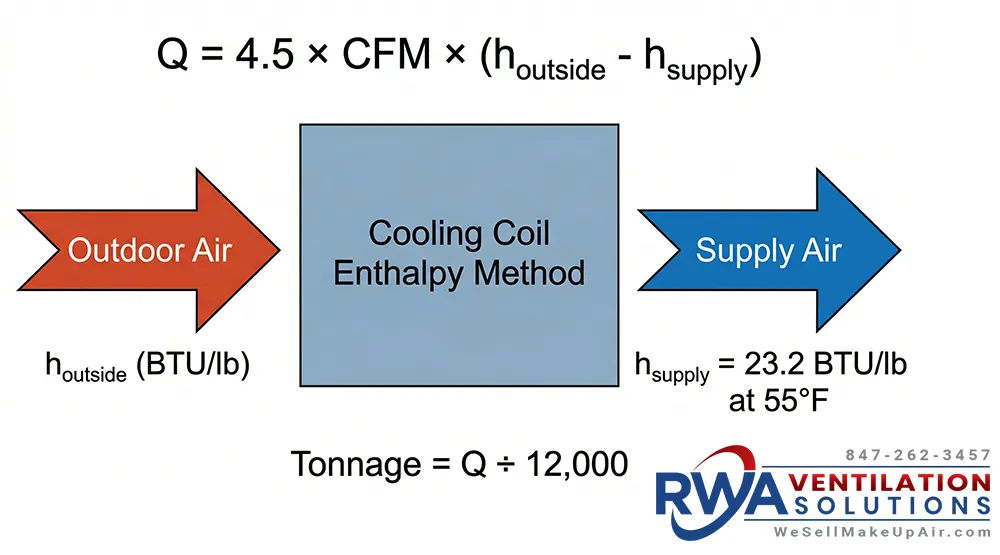
Q = 4.5 × CFM × (houtside – hsupply)
Tonnage = Q ÷ 12,000

DOAS Cooling and Dehumidification Formula

This formula calculates total cooling load using enthalpy, which captures both heat and moisture in a single value.

Total
Heat Rate

Airflow
Enthalpy
Difference
VariableDefinitionUnit
4.5Air density × 60 minutes (converts CFM to pounds per hour)Constant
CFMVentilation airflow from Panel 1 or your own valueCubic feet per minute
h_outsideEnthalpy of outdoor air at summer design conditionsBTU/lb
h_supplyEnthalpy of supply air (default 23.2 BTU/lb at 55°F saturated)BTU/lb
12,000BTU per ton of refrigerationConversion factor

The enthalpy method captures both sensible heat and latent moisture in a single calculation. Temperature-only formulas undersize DOAS equipment in humid climates because they ignore the energy required to condense water vapor. A 93°F day in Chicago carries far more cooling load than a 93°F day in Denver. Enthalpy accounts for that gap. Your heated and cooled make-up air unit specs depend on getting this number right.

How Do You Calculate Heating Load for a DOAS Unit?

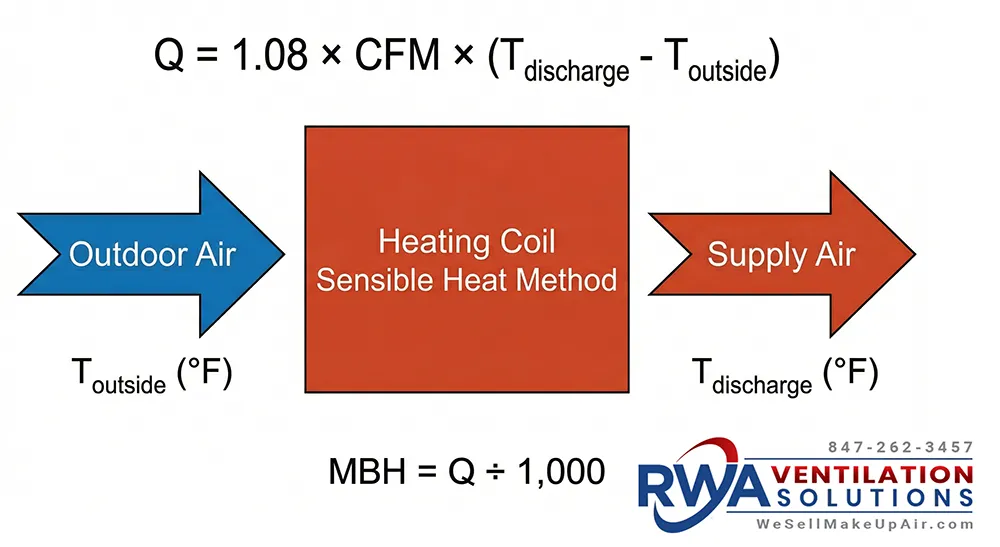
Heating load for a DOAS unit is a sensible-only calculation. No moisture variable needed. You measure the temperature difference between your target discharge and the coldest outdoor air your system will handle.

DOAS Heating Load Formula

Heat Rate Airflow Temp
Difference
Q = 1.08 × CFM × ΔT
MBH = Q ÷ 1,000
DOAS Heating Load Formula

This formula calculates the heat energy required to raise 100% outdoor air from winter design temperature to your discharge setpoint.

VariableDefinitionUnit
1.08Air density × specific heat × 60 minutes (converts CFM to BTU/hr per °F)Constant
CFMVentilation airflow from Panel 1 or your own valueCubic feet per minute
T_dischargeTarget supply air temperature leaving the unit°F
T_outsideWinter design temperature for your location°F
1,000BTU per MBH (thousands of BTU per hour)Conversion factor

Winter design temperatures vary dramatically by region. Chicago uses -6°F while Houston uses 28°F. That 34-degree spread changes your heating capacity requirement by more than 50% at the same CFM. The calculator pulls ASHRAE-based winter design data for ten major U.S. cities so your heating load matches real winter conditions.

When You Need More Than a Calculator

This tool gives you preliminary sizing numbers. It does not replace a full engineering review. Mixed-use buildings, variable occupancy zones, and projects with energy recovery all require analysis beyond what a calculator can deliver.

We spec DOAS units across multiple manufacturer lines and match equipment to your application, not a catalog. Every recommendation includes engineering review, selection assistance, and fast quoting.

If your project needs more than a number, we can help.

Have questions? Contact us