
How to Choose the Right Makeup Air Unit
Choosing the wrong makeup air unit costs you twice.
- Pick a direct-fired unit for a commercial kitchen and you’ll fail health inspection.
- Pick an indirect-fired unit for a warehouse and you’ll pay 15% more in fuel costs every year for efficiency you didn’t need.
The decision comes down to three factors: your application, your air quality requirements, and your budget for operating costs.
- Get it right and the system runs efficiently for decades.
- Get it wrong and you’re either ripping it out or overpaying every month.
Here’s how to match the right unit to your building.
We are the authorized distributors for the leading American manufacturers of makeup air units. We’ll be pleased to provide the ideal make up air unit for your application as authorized representatives.
For a fast quote or if you have inquiries about commercial or industrial MUA, get in touch with us.
Three Types of Makeup Air Units Compared
Most commercial makeup air systems use one of three heating sources: direct-fired gas, indirect-fired gas, or electric. Each serves different applications and comes with different tradeoffs.
| Unit Type | Efficiency | Air Quality Impact | Best Applications |
|---|---|---|---|
| Direct-Fired Gas | 92% or higher | Adds CO, CO₂, and moisture to supply air | Warehouses, manufacturing, large open industrial spaces |
| Indirect-Fired Gas | Around 80% | Combustion separated from supply air | Commercial kitchens, occupied spaces, food processing |
| Electric | 100% heat conversion | No combustion byproducts | Laboratories, cleanrooms, buildings without gas |
Direct-Fired Makeup Air Units
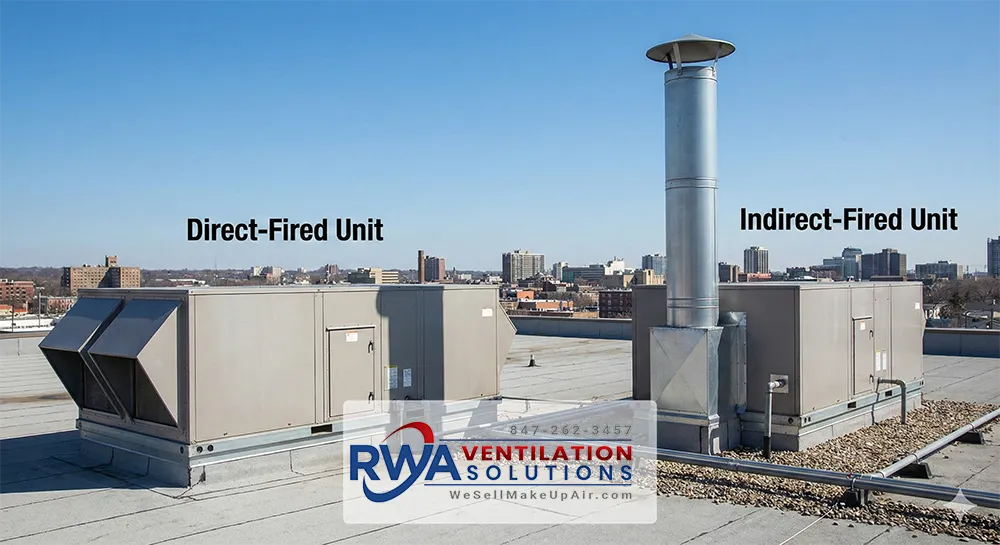
Direct-fired units burn natural gas directly in the supply airstream. Nearly all the heat goes into the air you’re moving because there’s no flue carrying heat outside. That’s why efficiency ratings hit 92% or higher.
The tradeoff is what comes with that heat. The burner adds small amounts of carbon monoxide, carbon dioxide, and water vapor to the supply air.
In large open spaces, this isn’t a problem. Warehouses, distribution centers, and open manufacturing floors have enough volume for these byproducts to dissipate well below any safety threshold. If you’re heating 10,000 CFM or more in a big box building, direct-fired delivers the lowest operating cost.
Best Applications for Direct-Fired Units
- Warehouses and distribution centers
- Manufacturing facilities with open floor plans
- Auto shops and service bays
- Agricultural buildings
Indirect-Fired Makeup Air Units
Indirect-fired units keep combustion gases completely separate from your supply air. The burner heats a metal heat exchanger, and supply air passes over that surface without ever touching the flame. Combustion exhaust vents outside through a flue.
You pay for that separation in efficiency. Expect around 80% compared to 92%+ for direct-fired. That 12% gap shows up on every gas bill.
But for many applications, indirect-fired isn’t optional. The FDA Food Code requires HVAC and makeup air systems that do not contaminate food or food-contact surfaces. Commercial kitchens, restaurants, bakeries, and food processing plants need clean supply air to pass health inspections.
Best Applications for Indirect-Fired Units
- Commercial kitchens and restaurants
- Food processing and packaging facilities
- Occupied office or retail spaces
- Healthcare facilities
- Schools and public buildings
Electric Makeup Air Units
Electric units eliminate combustion entirely. No gas, no burner, no byproducts of any kind. Just electric resistance coils heating clean outdoor air.
This makes electric the only choice for environments with the strictest air quality requirements. Laboratories, pharmaceutical manufacturing, and cleanrooms can’t tolerate even the trace contaminants that indirect-fired units might allow.
Electric also solves practical problems. No gas service to the building? Electric works. Rooftop installation where running gas lines is expensive or prohibited? Electric works. Local emissions regulations making gas permits difficult? Electric works.
The downside is operating cost. Electricity costs more than natural gas per BTU in most markets. Depending on your local utility rates, you could pay two to three times more to heat the same volume of air.
Best Applications for Electric Units
- Laboratories and research facilities
- Pharmaceutical and biotech manufacturing
- Cleanrooms
- Buildings without natural gas service
- Areas with strict emissions regulations
Makeup Air Unit Selection by Application
Use this table as a starting point. Your contractor can confirm the right choice based on local codes and your specific requirements.
| Your Application | Recommended Unit | Key Reason |
|---|---|---|
| Commercial kitchen | Indirect-fired gas | FDA Food Code compliance |
| Restaurant | Indirect-fired gas | Health department requirements |
| Warehouse | Direct-fired gas | Lowest operating cost, byproducts dissipate |
| Manufacturing floor | Direct-fired gas | High efficiency for high-CFM demand |
| Food processing | Indirect-fired gas | Clean air for product safety |
| Laboratory | Electric | Zero contamination tolerance |
| Cleanroom | Electric | Strictest air quality standards |
| Building without gas | Electric | No gas infrastructure needed |
What If You Need Heating and Cooling
Some applications require tempered air year-round. In summer, you need to cool incoming makeup air to avoid overloading your HVAC system. In winter, you need heat.
For these situations, consider a heated and cooled makeup air unit or a packaged rooftop unit that handles both functions in a single piece of equipment.
Next Steps
Once you know your unit type, you need to size it. Use our makeup air calculator to estimate your CFM and BTU requirements before requesting a quote.
Ready to talk specs? Contact us with your application details, and we’ll help you find the right equipment.

Scott Williamson
Scott Williamson is an engineer specializing in industrial ventilation, including make-up air units.
His expertise has been recognized by leading business publications like HubSpot and Tech Bullion. Scott helps business owners find high-performance solutions that balance energy savings with daily operational needs.